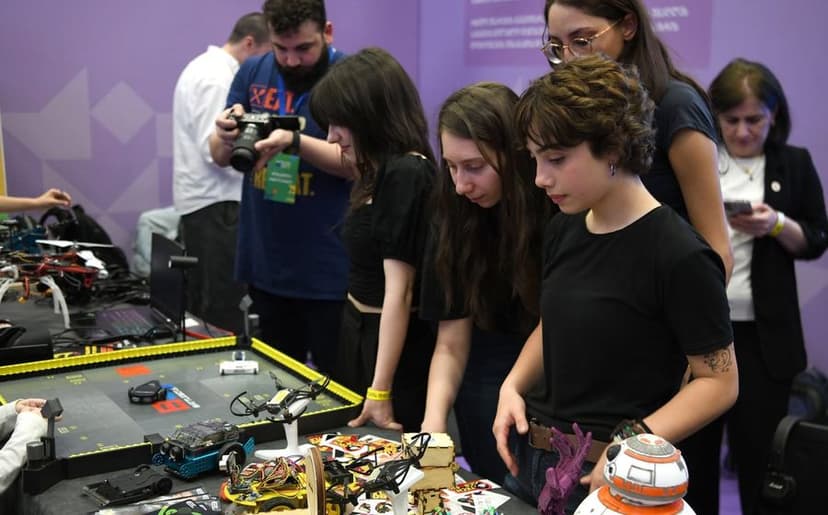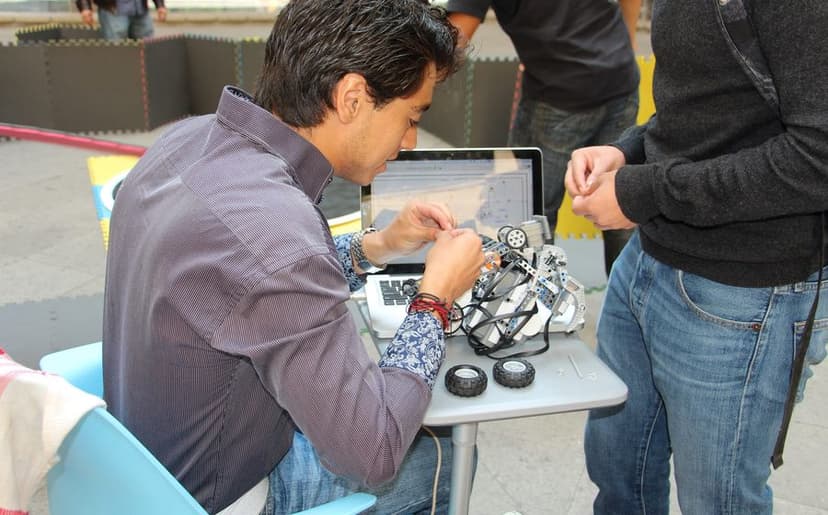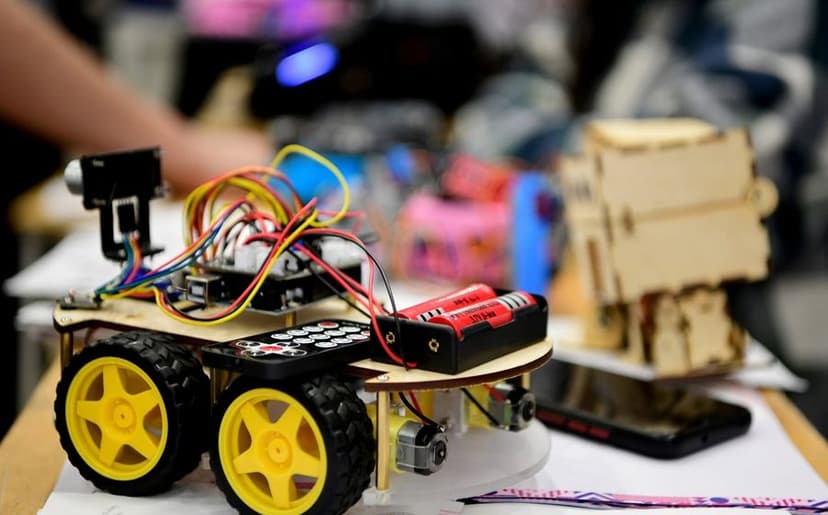








Robotics competitions for kids fall into two big groups. The first is simple formats where one robot does one task: sumo (push the opponent out of the ring), line following and mazes. The second is international programmes such as FIRST LEGO League (ages 6–16), WRO (ages 8–19) and RoboCupJunior (up to 19), where a team prepares a robot and a project over a season. For beginners, the best start is a school or local event with a simple robot.
Competitions are a powerful motivator for learning robotics. The deadline is fixed, the task is clear and the result is visible at once. Children discover that a robot that “always worked at home” can behave differently on a new table under different lighting. That is real engineering.
What types of robotics competitions are there?
| Format | What the robot must do | Typical ages | Difficulty |
|---|---|---|---|
| Robot sumo (mini sumo) | Push the opponent out of the ring | from 10 | Medium |
| Line following | Finish a black-line track as fast as possible | from 9 | Low to high |
| Maze | Find the exit with no human help | from 11 | Medium |
| FIRST LEGO League | Missions in 2.5 minutes plus a research project | 6–16, varies by country | Medium |
| WRO | Field missions, sports, an innovation project | 8–19 (up to 22 in one category) | Medium to high |
| RoboCupJunior | Soccer, rescue tasks, stage performance | up to 19 | Medium to high |
Rules differ between organisers, so always read the current rulebook of the specific event before you prepare. The numbers below come from official rules as of 2026.
Robot sumo: rules and how to prepare
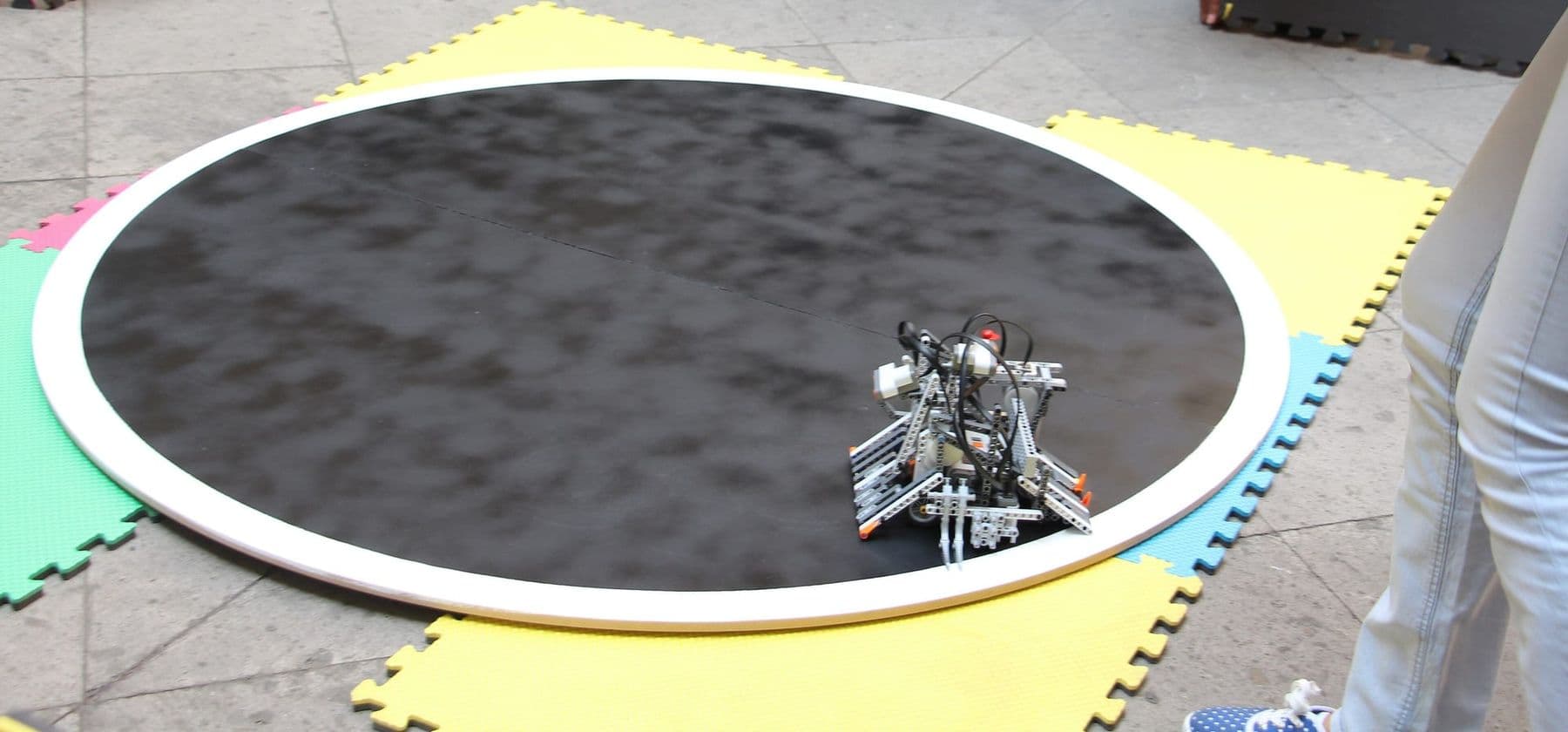
In robot sumo, two robots meet on a round ring (the dohyo) and each tries to push the other out. One of the best-known rulebooks is that of the All Japan Robot-Sumo Tournament (organised by FUJISOFT). In its main class:
- the robot must fit in a 20 × 20 cm box, with no height limit, and weigh no more than 3 kg;
- the ring is an aluminium disc 154 cm in diameter and 5 cm high, with a black surface and a 5 cm white border;
- an autonomous robot must start moving about 5 seconds after its start button is pressed;
- a game is three matches of three minutes, and the first to win two points (Yuko) wins;
- devices that disrupt the opponent (such as strobe lights), anything that releases liquid, powder or gas, throwing devices and suckers or glue that fix the robot to the ring are banned.
Children more often compete in mini sumo. For example, under the 2026 rules of the International MEB Robot Competition run by Türkiye's Ministry of National Education, the robot may be no larger than 10 × 10 cm and no heavier than 500 g, must be fully autonomous, and fights on a 77 cm ring with a 2.5 cm white border. Other organisers may set different sizes and weights.
How to build a good sumo robot:
- Low centre of gravity. Keep batteries and motors as low as possible; a tall robot tips easily.
- A wedge at the front. A sloped plate slides under the opponent and lifts its wheels off the ring.
- Grip. Rubber tyres and the full weight allowance: a heavy robot is harder to push.
- Edge sensors. Two downward-facing infrared sensors spot the white border, so the robot does not drive off by itself.
- A search strategy. Find the opponent with an ultrasonic or infrared sensor: spin on the spot until you “see” it, then attack at full speed.
Line following and mazes: speed and precision
A line-following robot has infrared sensors underneath that tell a black line from a white background. In the simplest version two sensors are enough: if the left one sees black, turn left. Fast robots use an array of five to eight sensors and a PID controller, which looks not only at how far the robot has drifted from the line but also at how fast the drift is changing. The result is smooth, fast motion instead of a zigzag.
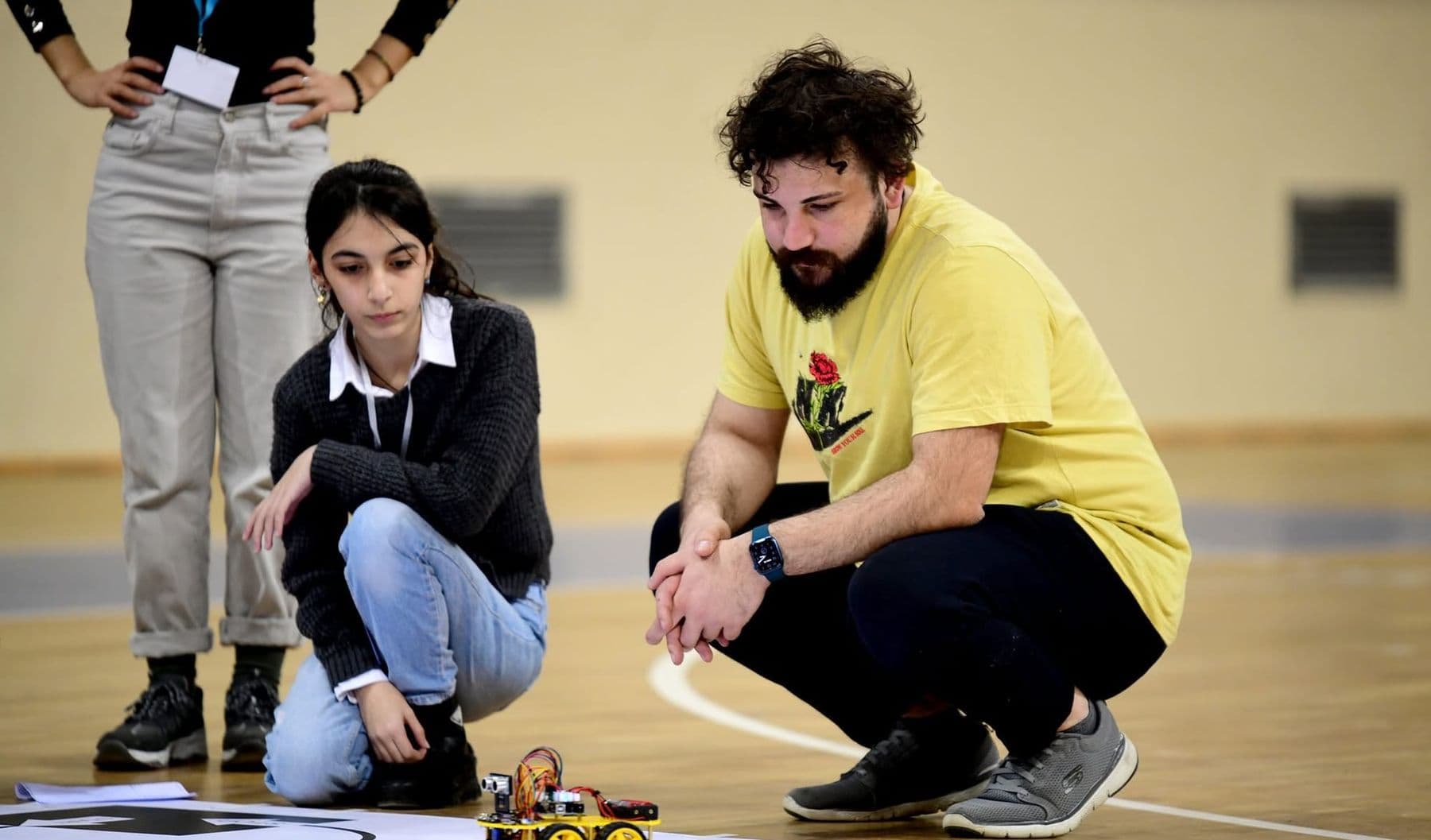
In the RoboCupJunior Rescue Line league, following the line is only the start. The robot follows a black line across a modular field, gets past obstacles, debris and hills, and finally sorts “victims” by colour and gently carries them to an evacuation point. In maze tasks, the robot measures walls with distance sensors and finds the exit with an algorithm, such as the right-hand rule: always keep following the right-hand wall.
FIRST LEGO League: how it works and what is changing
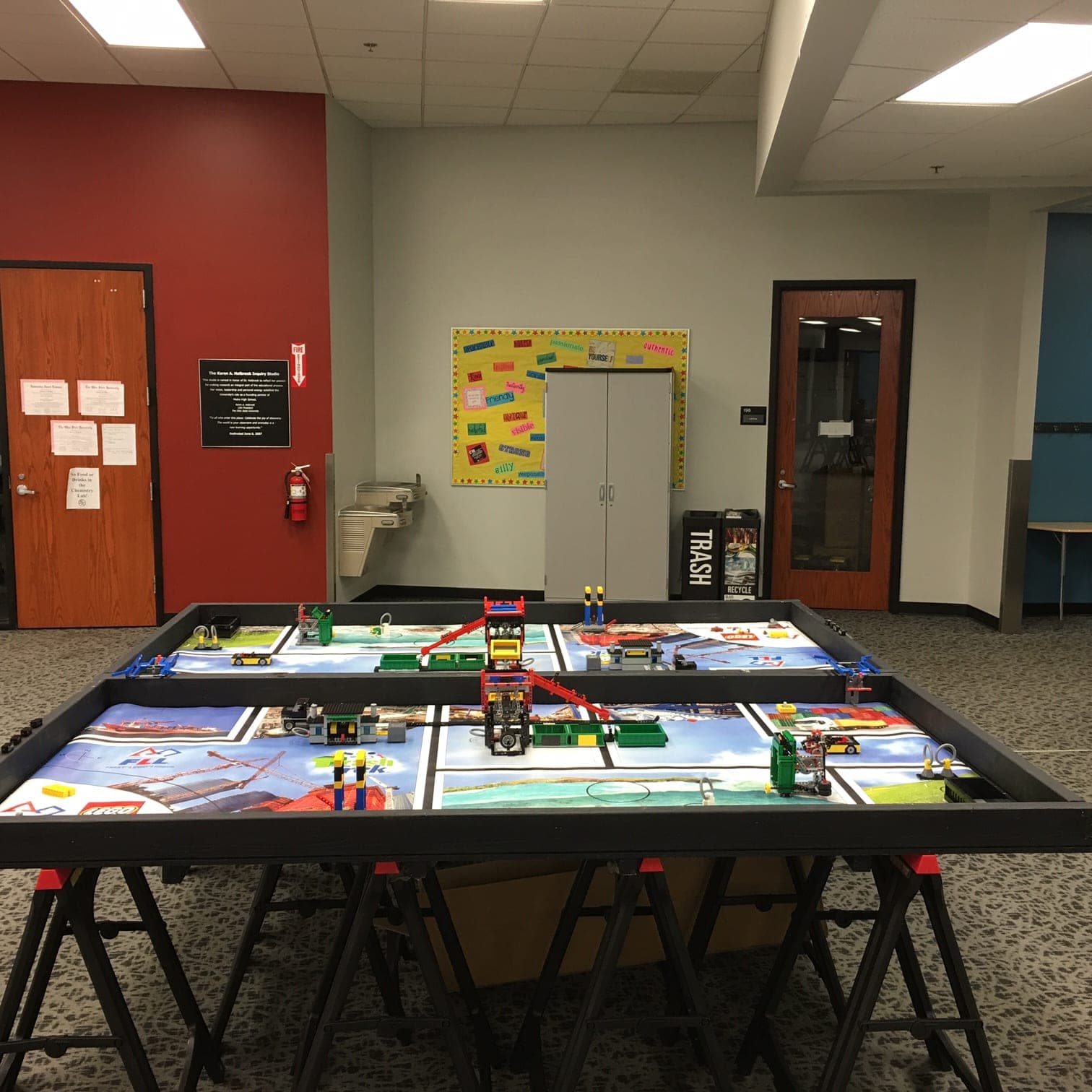
FIRST LEGO League (FLL) is one of the world's best-known STEM competitions for school-age children. The 2026–2027 season is called BIOGLOW, and its innovation project focuses on biodiversity. The Founders Edition has two levels:
- Explore (ages 6–10): teams work with LEGO Education SPIKE Essential and learn the basics of engineering;
- Challenge (ages 9–16, varies by country): teams program a SPIKE Prime robot to complete missions autonomously in two-and-a-half-minute matches.
Challenge scoring has four parts. In the robot game, each team plays several official matches and the highest score counts. The other three, the innovation project, robot design and Core Values, are scored by judges in presentations. In other words, a robot that drives well is not enough to win.
An important change: according to FIRST's official page, the 2026–2027 season, BIOGLOW, will be the final season of the programme, ending a partnership between FIRST and LEGO Education of nearly three decades. LEGO Education, for its part, says on its own page that it is retiring the SPIKE line, that SPIKE kits can still be used in FIRST LEGO League through the 2027–2028 season, and that teams should then move to the new LEGO Education Computer Science & AI kits. If you are preparing an FLL team, follow updates from your local organiser.
WRO: World Robot Olympiad categories
The World Robot Olympiad (WRO) is for students aged 8–19, with tournaments in dozens of countries. The 2026 theme is “Robots Meet Culture”. A team is 2–3 students plus a coach. The categories are:
| Category | Ages | Task | Robot size |
|---|---|---|---|
| RoboMission | 8–12, 11–15, 14–19 | Autonomous missions on a field that changes every round | max 25×25×25 cm |
| RoboSports | 11–19 | Two autonomous robots play a sport (currently Double Tennis) | max 20×20×20 cm, 1.2 kg |
| Future Innovators | 8–12, 11–15, 14–19 | A robot project for a real-world problem, presented to judges | fits a 2×2×2 m booth |
| Future Engineers | 14–22 | An autonomous car with steering on a track | max 30×20×30 cm |
In WRO, hardware and software are a free choice: LEGO, Arduino or another controller, as long as it meets the rules. The core of the WRO ethics code is that the team designs its own robot and writes its own software. Coaches and parents guide, but they do not do the work for the team.
RoboCupJunior and the FIRST Global Challenge
RoboCupJunior is the education branch of RoboCup for students up to 19. Its main leagues are Soccer (autonomous robots play two-on-two), Rescue (Line, Maze and Simulation) and OnStage (robot performances with music and costumes). The 2026 international RoboCup took place in Incheon, South Korea.
The FIRST Global Challenge is an annual competition between national teams of high-school-age students, who build robots from a standard kit of parts. According to FIRST Global, Georgia sent a national team in 2025 (students aged 14–17 from Tbilisi), and national qualifiers for the event are held in the country.
How to prepare a team for a competition: an 8-week plan
| Week | What to do |
|---|---|
| 1 | Read the rules together, break the task into parts, assign roles |
| 2 | A base robot: chassis, motors, one sensor. It just has to move |
| 3–4 | Program the main mission or behaviour, test at every session |
| 5 | Build a practice field to official dimensions, time the runs |
| 6 | Reliability: 10 runs in a row, log every failure |
| 7 | Engineering notebook, presentation, rehearse explaining the code |
| 8 | A dress rehearsal under competition conditions, pack a spares bag |
At many competitions the winner is decided by reliability, not speed: a robot that completes the task nine times out of ten often beats one that is record-fast once.
Bring charged spare batteries, a screwdriver, electrical tape, spare wires and a USB cable to the event. Save a working version of the code separately, so a last-minute change cannot ruin everything. The children should be able to explain why the robot works the way it does: judges will ask.
What do judges look for?
- Results on the field: points, time, missions completed;
- reliability: how consistently the robot performs across attempts;
- engineering decisions: why you chose this sensor, these wheels, this algorithm;
- independence: whether the children built and programmed the robot themselves;
- teamwork and conduct: respect for opponents, helping each other, handling stress.
If your teenager wants serious preparation, our course “Electronics and Robotics (Advanced)” in Tbilisi for ages 13–17 covers Arduino C++, sensors, a 4WD robot and a robotic arm, and ends with an in-course robot competition. For ages 10–14, the course Robotics: from mBot to a Robotic Arm ends with a team competition and a final. Every level, starting from age 7, is on our robotics courses for kids page.
 Course at TDSRobotics, Electronics and Smart Systems: From a Smart City to Autonomous Robots7 months · 3 phases · 72 h · Starts 20 NovDetails
Frequently asked questions
What age can a child enter a robotics competition?
FIRST LEGO League Explore starts at 6 and WRO's youngest age group at 8. In simple school events such as line following, 9–10-year-olds do well after a month or two of robotics. What matters is that the child builds and programs the robot themselves.
Do you need an expensive robot to compete?
No. A simple Arduino robot is enough for sumo and line following, and WRO allows a free choice of hardware. FLL still uses LEGO kits, so it helps if the school or club already has them. To build your first robot, follow our guide how to build your first robot with Arduino.
WRO vs FLL: which should we choose?
FLL is a seasonal programme where the research project and team values count as much as the robot game. WRO is more robot-focused: precise field missions, free choice of hardware and clear age groups. If your child loves presenting and research, FLL fits; if it is pure engineering, WRO.
How do we find a robotics olympiad in Georgia?
International programmes are run by national and regional organisers: the WRO website lists its national organisers, and FLL events are run by regional partners. Ask your school's STEM club leader or robotics teacher too, because news about school and regional events often travels through them.
How does competing help a child?
A competition gives learning a real goal and a deadline. Children learn to plan, cope with failure, agree as a team and present their work to strangers. Those skills are useful far beyond robotics.
How to get started
The road to a competition starts with one simple robot that works reliably. If you are still choosing a course, read how to choose a robotics class for kids. If you want your teenager to prepare with a teacher, see Electronics and Robotics (Advanced) or book a free consultation.
Sources
- Robot-Sumo: Definition of a match, All Japan Robot-Sumo Tournament (FUJISOFT)
- Mini Sumo 2026, Robot Competitions, Ministry of National Education of Türkiye
- FIRST LEGO League, FIRST
- FIRST LEGO League Challenge: judging and robot game, NYC FIRST
- SPIKE update 2026, LEGO Education
- WRO Categories, World Robot Olympiad Association
- Welcome to WRO 2026, World Robot Olympiad Association
- RoboCupJunior
- Team Georgia 2025, FIRST Global