















What is artificial intelligence? Put simply, it is software that learns from examples and then does tasks that used to need a human mind: it recognises faces in photos, translates, writes text, answers questions and plans routes. The short name is AI, and it is less mysterious than the headlines suggest.
An ordinary program follows rules a person writes step by step. An AI system is shown thousands or millions of examples instead and finds the patterns itself, the way a child learns to recognise a cat: nobody explains “four legs, whiskers, tail”; the child sees many cats and then recognises a new one at once.
AI is a field of science dating from the 1950s and a family of technologies, from your phone camera to ChatGPT. As of October 2026, the best-known AI assistants are ChatGPT, Gemini, Claude, Grok and Copilot; which suits which job is in our guide to AI apps.
What is artificial intelligence, in simple words?
Every AI system has three ingredients:
- Data: the examples it learns from (photos, texts, recordings, spreadsheets).
- A model: a mathematical “formula” with millions or billions of adjustable parameters, tuned during training.
- Computing power: mostly graphics processors (GPUs); training a large model takes weeks or months.
The output is always a prediction. Is this email spam? Is that a dog or a cat? Which word comes next? How long will the drive across Tbilisi take? AI does not think like a person; it works with probabilities and picks the most likely answer given what it has seen. So it cannot be better than its examples: if they contain errors or bias, the model repeats them.
AI vs machine learning vs deep learning vs generative AI: what is the difference?
These terms nest inside each other like Russian dolls: each is part of the one before.
| Term | What it is | Example |
|---|---|---|
| Artificial intelligence (AI) | The whole field: machines doing “smart” tasks | Chess program, navigation app |
| Machine learning | AI that learns its rules from data | Spam filter, card fraud checks |
| Deep learning | Machine learning with many-layered neural networks | Face recognition, speech-to-text |
| Generative AI | Deep learning that creates new content | ChatGPT, Gemini, image generators |
A neural network is inspired by brain neurons but is not a copy of the brain: it is a chain of mathematical layers, and “deep” means there are many of them.
Machine learning learns in three main ways:
- Supervised: from labelled examples (“spam”, “not spam”).
- Unsupervised: it finds groups in data by itself, such as similar customers.
- Reinforcement: by trial and error with rewards. AlphaGo grew stronger this way, playing a huge number of games against itself.
How does the AI that talks to you work?
Behind ChatGPT, Gemini and Claude sits a large language model (LLM). It works in three stages:
- Reading and guessing. In training, the model “reads” enormous amounts of text split into small pieces called tokens (a word, part of a word, a punctuation mark) and practises one task billions of times: guess the next token.
- “Upbringing”. People show it good answers and rate its replies, so it learns to follow instructions, stay polite and refuse dangerous requests.
- Answering. It writes your answer token by token, choosing the best-fitting continuation. Type “The capital of Georgia is” and the next word will almost always be “Tbilisi”.
Why can it be confidently wrong? It does not look anything up; it produces text that looks right. When it does not “know” the answer, it can still write a convincing invented fact, called a hallucination. A 2025 paper by OpenAI researchers argues that one reason is that training and evaluation reward guessing over saying “I don’t know”.
Today’s assistants also search the web, read your files and run code, which reduces mistakes but does not remove them. Once AI can take actions, such as sending an email, it becomes an agent: see AI agents: what they are and how they work.
Types of AI: narrow, general and superintelligence
| Type | What it means | Exists? |
|---|---|---|
| Narrow AI | Strong at one or a few kinds of task | Yes: all of today’s AI |
| General AI (AGI) | Almost any mental task at human level | No |
| Superintelligence (ASI) | Beats humans at everything | No, a hypothesis |
Narrow AI can beat people: no world champion beats a modern chess engine, yet that engine cannot write an email. ChatGPT and similar assistants are broader. In a 2023 framework by Google DeepMind researchers, such chatbots sit at the lowest, “emerging” level of general AI, while the level of a skilled adult (“competent AGI”) is not considered reached.
Honestly put: as of October 2026, AGI does not exist and has no agreed definition, and experts disagree on when or whether it will arrive. Headlines saying “AI beats humans” are usually about one specific test.
The history of AI: from 1950 to today
| Year | Event |
|---|---|
| 1950 | Alan Turing asks whether machines can think and proposes the “imitation game” |
| 1956 | Dartmouth workshop: the field is born; John McCarthy coins “artificial intelligence” |
| 1966 | ELIZA, one of the first chatbots (Joseph Weizenbaum, MIT) |
| 1970s–80s | “AI winters”: funding dries up after overblown promises |
| 1997 | IBM’s Deep Blue beats world chess champion Garry Kasparov |
| 2012 | Deep learning breakthrough: AlexNet wins an image recognition contest by a wide margin |
| 2016 | AlphaGo beats Go master Lee Sedol 4–1 |
| 2017 | Google researchers publish the transformer, the basis of today’s language models |
| 2022 | ChatGPT launches on 30 November |
| 2024 | Nobel Prizes for neural networks (Hopfield, Hinton) and AlphaFold; the EU AI Act enters into force |
Today’s boom rests on three things: huge amounts of internet data, powerful GPUs and the transformer.

Uses of AI: where you meet it every day
You have probably met AI several times today already:
- Maps: Google Maps predicts traffic and arrival times from historical and live data.
- Bank cards: a system spots an unusual payment and blocks it or asks you to confirm.
- Translation: Google Translate uses neural networks, for Georgian too.
- Phone cameras: night mode, portrait blur and face unlock rely on machine learning.
- Email: Gmail filters spam and phishing with machine learning.
- Recommendations: YouTube, TikTok, Instagram and Netflix suggest what you will likely watch.
- Chat assistants: ChatGPT, Gemini and Claude help you write, explain and summarise.
Businesses use AI to answer customers, process invoices and forecast sales; see AI in business: 15 use cases.
What AI is and is not: abilities and limits
| AI does well | AI does badly or cannot do |
|---|---|
| Writing, editing, summarising | Exact facts without checking a source |
| Translating, explaining simply | Recent news, if web search is off |
| Finding patterns in large data | Taking responsibility for a decision |
| Creating images, voice, video | Knowing your situation unless told |
| Writing and debugging code | Georgian nuance at English level |
AI has no wishes, feelings or life experience; its “understanding” is statistical. Think of a very fast, well-read assistant that is sometimes overconfident, so you check its work.
Are AI and robots the same thing?
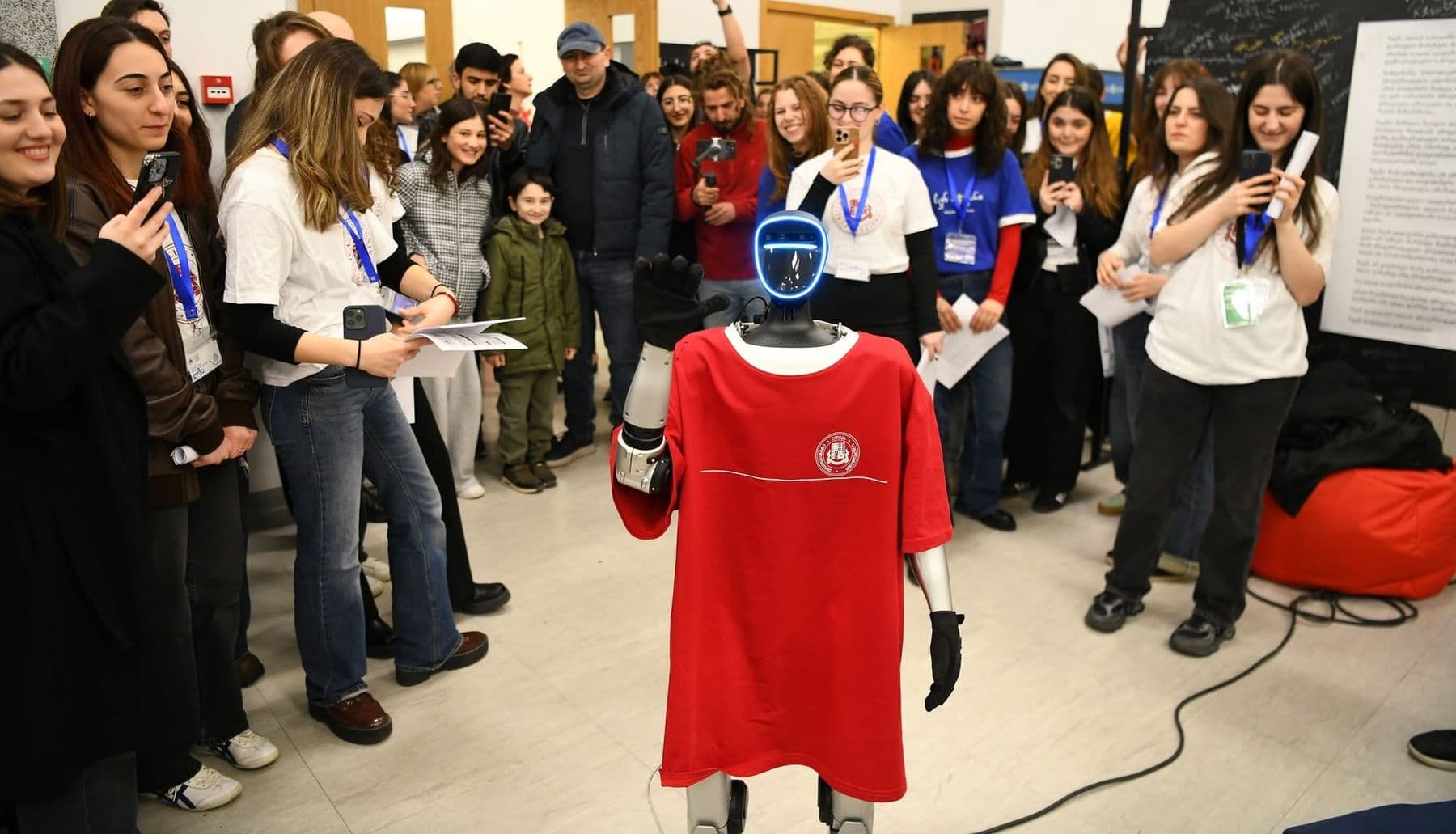
No. A robot is a physical machine with motors, sensors and a body. AI is software that can be a robot’s “brain”, but most AI has no body and lives in a phone or a server. Many robots, such as factory arms, use no AI at all. Humanoid robots often combine both.
What are the risks of artificial intelligence?
- Hallucinations: invented facts, quotes and links. Check important information in an official source.
- Personal data: chats are stored on company servers and, depending on settings, may train models. Keep ID numbers, card details, health and customer data out.
- Bias: if a company mostly hired men, a system trained on its data may rate women’s CVs unfairly low.
- Deepfakes: in 2024 an Arup employee in Hong Kong transferred about 25 million US dollars after a video call with a fake “CFO” and fake colleagues. If someone urgently asks for money, call back on a number you know.
- Energy: the IEA estimates data centres used about 1.5% of world electricity in 2024; in its base case this roughly doubles by 2030, driven mainly by AI.
- Children: see our guide on how kids can use AI safely.
Run three checks on every AI answer. Verify numbers, dates and names in an official source. Open every link to see that it exists. For legal questions, compare with the current official text (in Georgia, matsne.gov.ge). If you cannot find the source, assume it does not exist.
AI regulation: the EU AI Act and Georgian law
The EU AI Act, the world’s first comprehensive legal framework for AI, sorts systems by risk:
| Risk | Rule | Example |
|---|---|---|
| Unacceptable | Banned | Social scoring, emotion recognition at work and school |
| High | Strict requirements, human oversight | CV screening, credit scoring |
| Transparency | People must know it is AI | Chatbots, deepfakes |
| Minimal | No specific rules | Spam filters, video games |
It entered into force on 1 August 2024; bans have applied since 2 February 2025, general-purpose model rules since 2 August 2025, and most of the Act, including transparency, since 2 August 2026. The AI Omnibus amendments (in force July 2026) moved high-risk deadlines to 2 December 2027, or 2 August 2028 for AI in regulated products, and ban AI that creates intimate images without consent from 2 December 2026. Georgia is not in the EU, but the Act applies to Georgian companies whose AI products are placed on the EU market or used there.
As of October 2026, Georgia has no separate AI law. The main framework is the Law on Personal Data Protection (adopted 14 June 2023, main provisions in force since 1 March 2024):
- Processing personal data needs a legal basis, such as consent, a contract or the law.
- Article 19 gives people the right not to be subject to solely automated decisions, including profiling, with legal or similarly significant effects, except with explicit consent, a contract or a legal provision; even then they can ask for human involvement and contest the decision.
- Since 2 March 2026, the State Audit Office has taken over the functions of the Personal Data Protection Service.
Where to start: first steps with AI
- Pick one free assistant: compare them in ChatGPT, Claude or Gemini: which one for which job.
- In the settings, decide whether your chats may train models.
- Give it a real task: an email, an explanation, a summary.
- Ask about something you know well and count the mistakes.
- Follow how to use AI: a 7-day plan for beginners.
To go deeper, three paths (user, automation builder, engineer) are in how to learn AI. If you want AI at work to do tasks, not just answer questions, on the AI Employees course you build your own bot in four hands-on sessions, without code.
 Course at TDSAI Employees: Grok Bot and ChatGPT Dots2 weeks · 10 hDetails
For other roles, see our AI courses.
Frequently asked questions
What is artificial intelligence, in short?
Artificial intelligence is a computer system that learns from examples and does tasks typical of the human mind: recognising, translating, writing, predicting. Today’s AI is “narrow”: strong at specific jobs, but it does not think in general the way people do.
Who invented artificial intelligence?
No single person. Alan Turing’s 1950 paper is one foundation, and John McCarthy coined the term for the 1956 Dartmouth workshop. Today’s neural networks build on many scientists, including Geoffrey Hinton, a 2024 Nobel laureate.
Is ChatGPT artificial intelligence?
Yes. ChatGPT is a generative AI assistant running on OpenAI’s large language models. It predicts the next token, so it writes well but can be confidently wrong.
Is artificial intelligence dangerous?
AI is a tool with benefits and risks. Today’s real risks are concrete: invented facts, data leaks, biased decisions and deepfake fraud, which laws such as the EU AI Act and Georgia’s data protection law aim to limit.
Is AI conscious?
There is no scientific evidence that today’s AI systems are conscious or have feelings. When a chatbot writes “I’m glad”, it produces text resembling what a person would write. Some researchers study the question seriously, but it remains open.
Where can I learn AI?
Start free with one assistant and a course such as Elements of AI. A plan from zero is in how to learn AI. For work, a practical course on your own tasks is the faster route.
Next step
Now you know what AI is, where it helps and where to be careful. Try one real task today. If you want to use AI at work systematically but are unsure which course or tool fits, contact us for a free consultation.
Sources
- The Turing Test, Stanford Encyclopedia of Philosophy
- Why Language Models Hallucinate, Kalai et al., arXiv
- Levels of AGI for Operationalizing Progress on the Path to AGI, Google DeepMind, arXiv
- AI Act: Regulatory framework on AI, European Commission
- Law of Georgia on Personal Data Protection, Legislative Herald of Georgia
- Data protection laws in Georgia, DLA Piper
- Energy and AI: Executive summary, IEA
- British engineering giant Arup revealed as $25 million deepfake scam victim, CNN