













In 2026, the best tech course for an adult is the one that serves a specific goal. An AI course can save you time at work within 4–5 weeks, while 3D modelling, laser cutting and CNC give you a craft and the basis for a small business in 6–8 weeks. Choose by goal, by time and by what you will hold in your hands at the end.
Many people think adult tech courses are only for career changers. In reality the most common reason is simpler: a new tool appeared at work, or you have had an idea for years and want to make it. This guide shows which course in Tbilisi serves which goal and how much time it takes.
Why learning tech as an adult pays off in 2026
The World Economic Forum’s Future of Jobs Report 2025 gives a few clear numbers:
- employers expect about 39% of workers’ existing skills to change or become outdated over 2025–2030;
- if the world’s workforce were 100 people, 59 would need training by 2030;
- the top three fastest-growing skills are AI and big data, networks and cybersecurity, and technological literacy.
This does not mean everyone must become a programmer. It means accountants, managers, designers and craftspeople will all need to learn new tools. Adults have a real advantage here: they know why they are learning and test new knowledge on their own work right away.
Three goals: what do you need a course for?
Before choosing, answer one question: what should you be able to do in three months that you can’t do today? The answer usually falls into one of three groups:
- AI at work. You want emails, reports, research and routine tasks to take less time. A short course brings quick results here: 16–20 hours.
- A craft and a small business. You want to make and sell souvenirs, signs, furniture parts or spare parts yourself. That calls for digital fabrication: 3D printing, laser or CNC.
- A career change. The longest road. One course is not enough, but a good one gives you the foundations and the first pieces of a portfolio.
Which AI course should you choose?
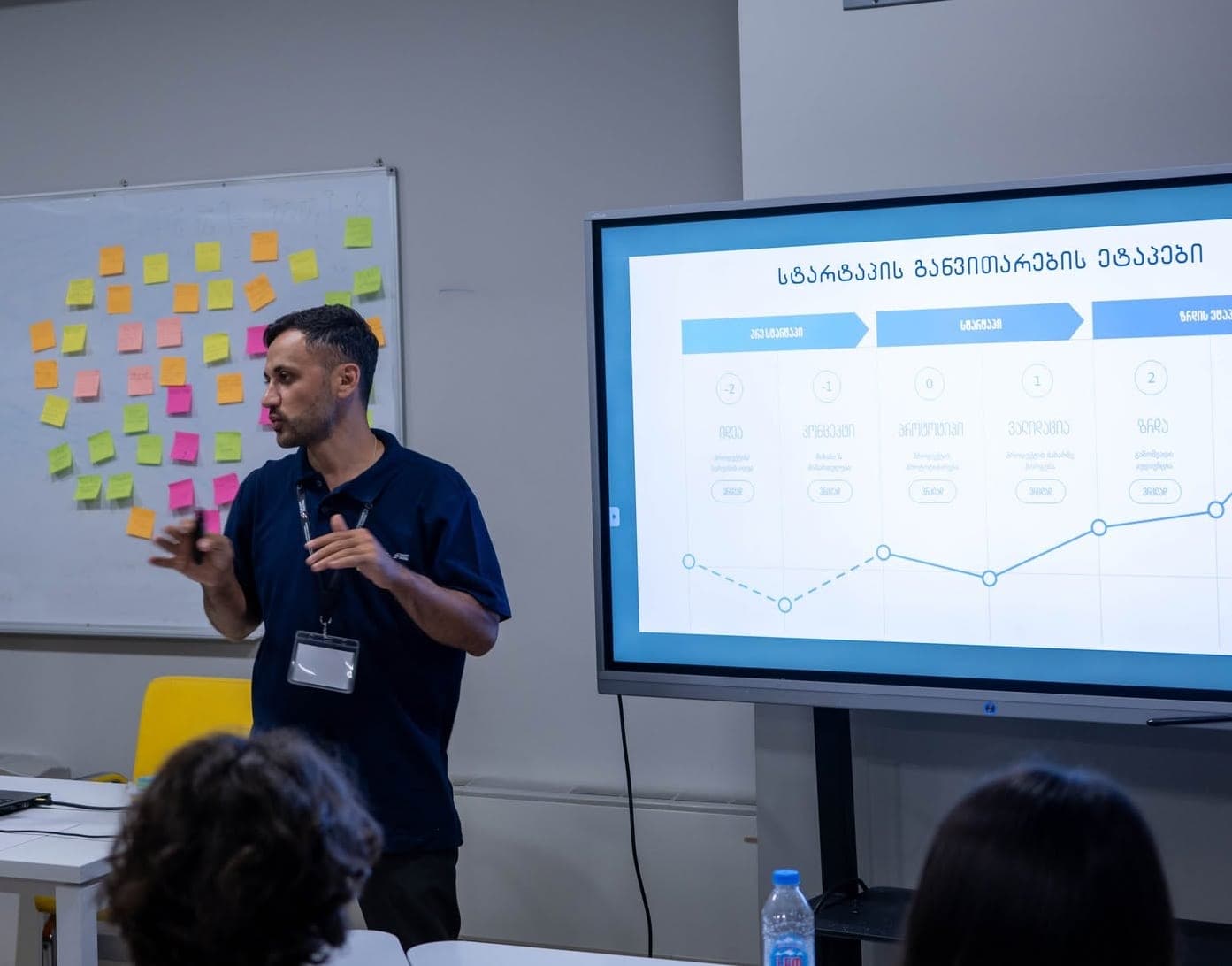
Choose an AI course by profession, not “AI in general”. The same ChatGPT helps an accountant, a designer and a teacher with completely different things. Our open-enrolment AI courses run 16–20 hours in a hybrid format:
- [AI for Business: Automation and Agents](/courses/ai-business): 5 weeks, 20 hours. You build an assistant that answers from company documents, an automated flow (form, sheet, email) and an agent that prepares the weekly report. No coding: Zapier, Make and n8n are visual editors.
- [AI for Designers: From Idea to Finished Visual](/courses/ai-designers): 4 weeks, 16 hours, intermediate. Basic Photoshop or Figma is required.
- [AI for Motion Designers: Video, Animation and Sound](/courses/ai-motion-design): 4 weeks, 16 hours. Video, animation, Georgian voice-over and a 30–45 second spot.
- [AI for Teachers](/courses/ai-teachers): 4 weeks and 16 hours, built around education.
- [AI for Companies: Corporate Program](/courses/ai-business-corporate): 30–50 hours, shaped around your company’s processes.
The full map of AI courses is in our guide on how to choose an AI course. If you are not sure what AI can do for a business, start with 15 AI use cases for small and medium companies. Our courses are compared side by side on our AI courses page.
3D modelling and printing course: from idea to object
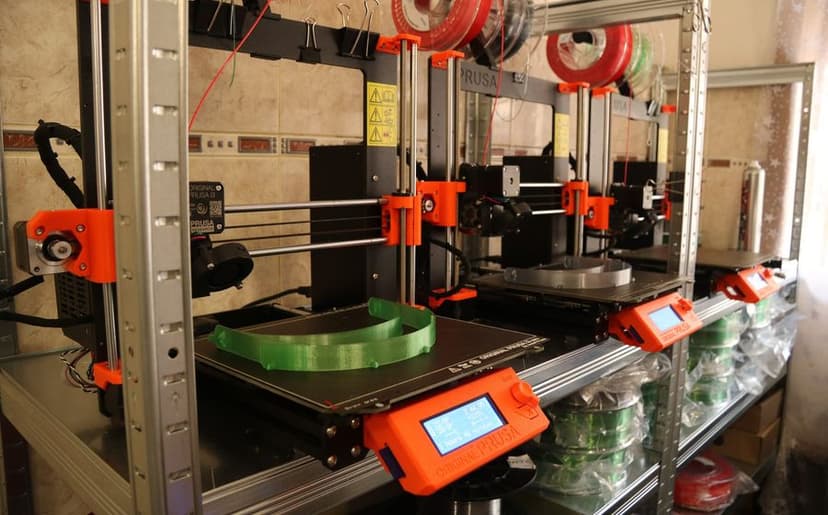
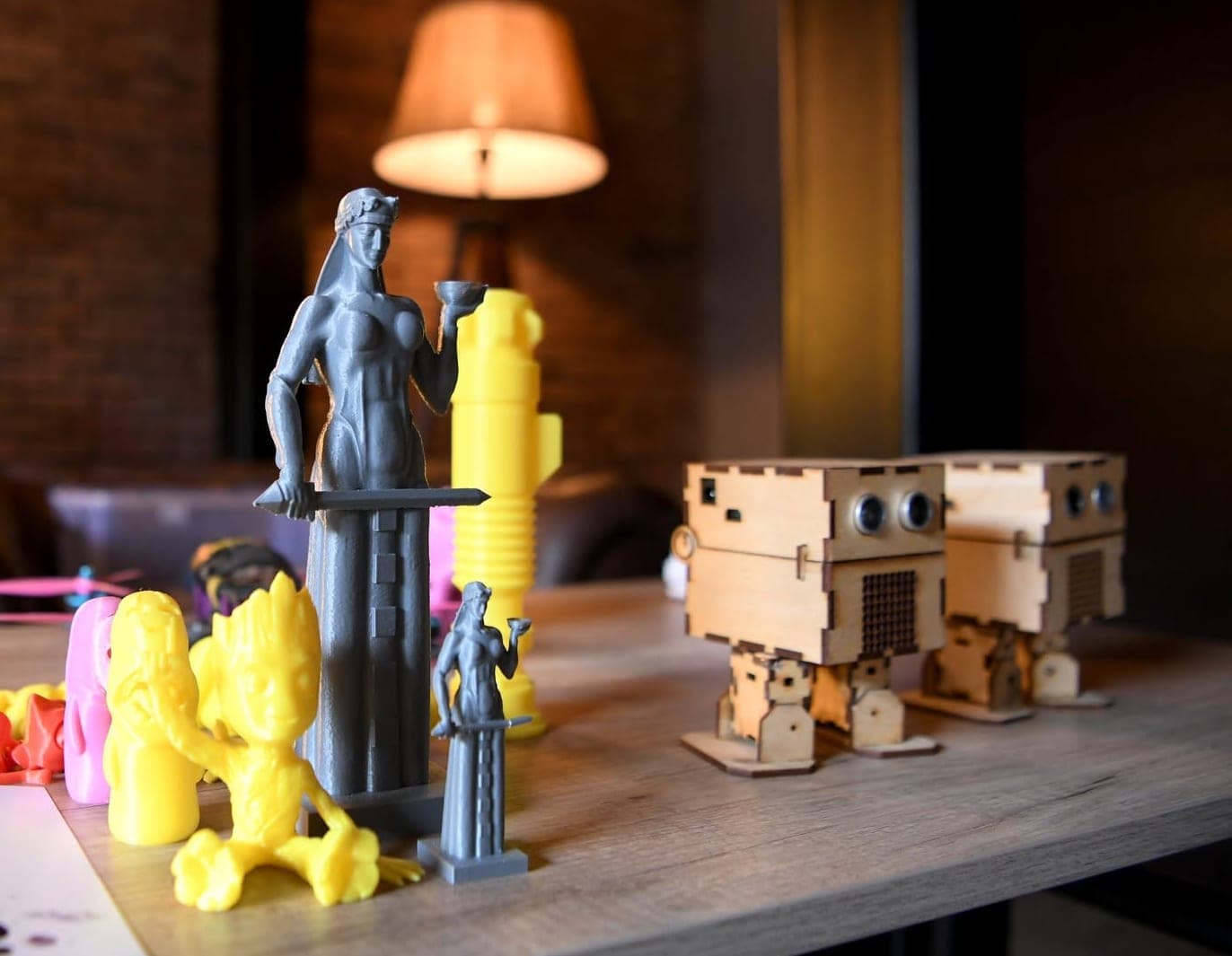
A 3D course is for anyone who wants to design something on a computer and then print it: a spare part, a bracket, a prototype, a souvenir. Our 3D Design & 3D Printing course runs 6 weeks and 36 hours. You learn parametric modelling in Fusion 360, parts that fit together (0.2 mm tolerance), slicing and materials: PLA, PETG, TPU. It is taught in Georgian and English.
For practice at home, Autodesk offers a free version of Fusion for personal use with limited features. As of 2026 it is for home-based, non-commercial projects only, and Autodesk’s US page caps the revenue you make with it at 1,000 USD a year. If you plan to sell, you will need a commercial licence.
More in 3D printing course for adults and PLA, PETG or ABS. To try it in a single day, there is the 3D Printing: A Useful Household Item in One Day workshop.
Laser cutting course: souvenirs, signs, packaging
Laser cutting is the fastest route to a sellable product. A wooden box, an engraved board, an acrylic sign or a leather keyring cut in minutes once the file and settings are right. Our Laser Cutting & Engraving course runs 6 weeks and 36 hours: file preparation in CorelDRAW, LightBurn, a 100 W CO₂ laser with a 1300×900 mm bed, plywood, MDF, acrylic and leather.
You make a test matrix of 10–90% power and 5–400 mm/s speed, so you leave with your own settings chart for every material. Safety comes on day one: fume extraction, fire risk and materials that must never go under a laser, such as PVC.
More in laser cutting and engraving course and CO₂ or diode laser. For a one-day start, try the masterclass Make a Wooden Box with a Laser.
CNC course: furniture, large formats and precise parts
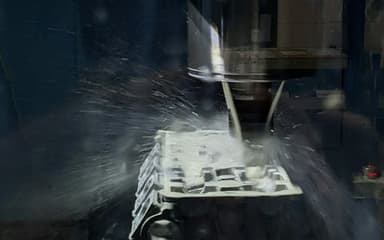
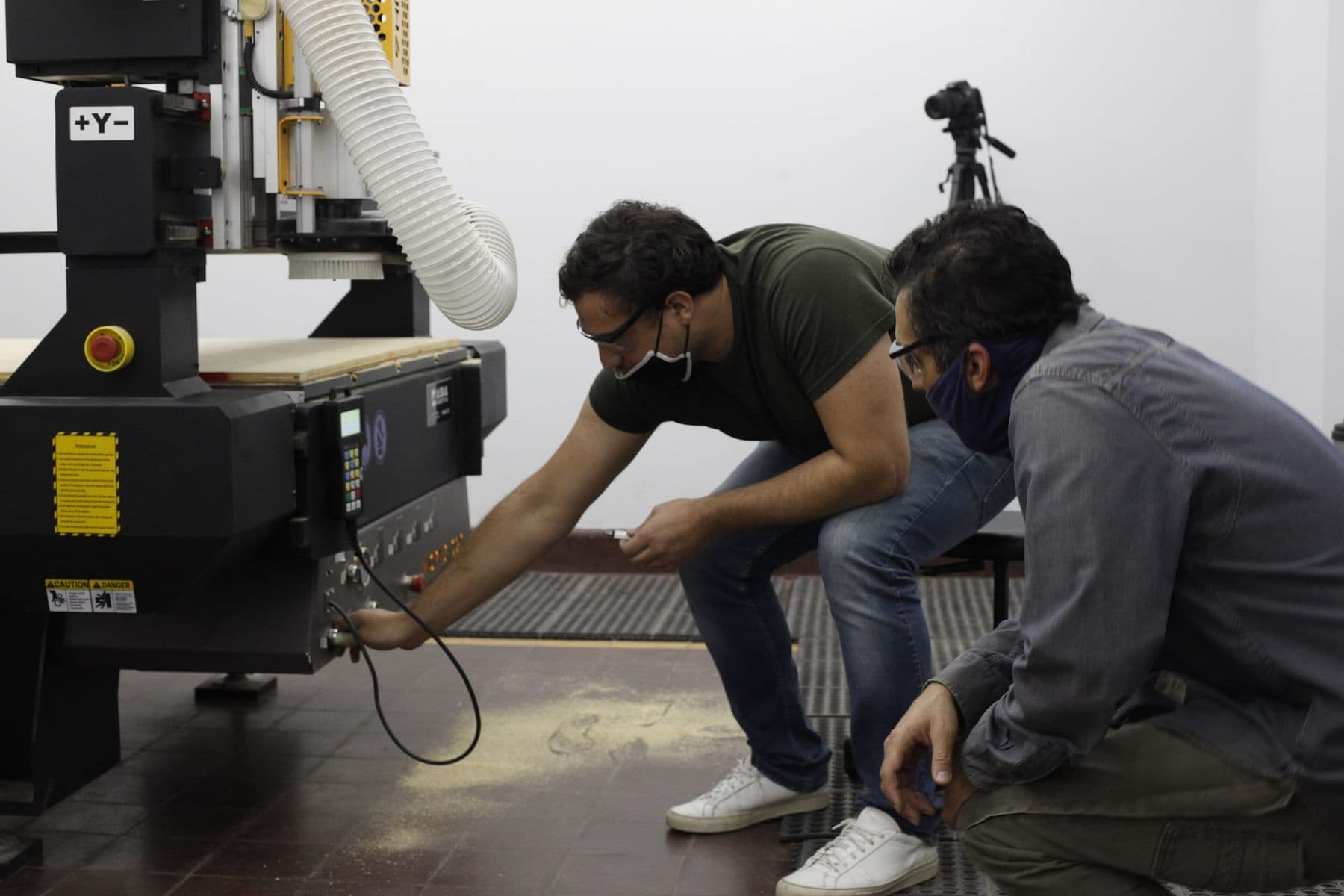
A CNC router is the next step after the laser: it cuts thick plywood and MDF, carves reliefs and makes furniture parts. Our CNC Machining: 3D Design, CAM & Operation course runs 8 weeks and 48 hours at intermediate level: 2D and 3D models, CAM toolpaths in VCarve Pro and Fusion 360, choosing bits, spindle speed and feed rate, workholding and reading G-code, on a 1300×2500 mm bed. The laser course is not a prerequisite, but knowing a vector program helps.
More in what you learn on a CNC course and 7 file-prep mistakes for CNC.
Comparison table: hours, outcome and who it suits
| Course | Length | What you finish with | Best for |
|---|---|---|---|
| AI for Business | 5 weeks, 20 h | Assistant, automation, agent | Owners, managers, office staff |
| AI for Designers | 4 weeks, 16 h | A brand mini-book for your portfolio | Designers, SMM |
| AI for Motion Designers | 4 weeks, 16 h | A 30–45 second spot | Motion designers, editors |
| AI for Teachers | 4 weeks, 16 h | A complete teaching unit | Teachers of any subject |
| 3D Design & 3D Printing | 6 weeks, 36 h | Your own product | Designers, engineers, founders |
| Laser Cutting & Engraving | 6 weeks, 36 h | Your own product and settings | Beginners, small businesses |
| CNC Machining | 8 weeks, 48 h | A furniture part and a sign | Makers, furniture makers |
| AI for Companies | 30–50 h | Pilot automations, AI policy | Teams, departments |
Self-study on YouTube or a course in a lab?
There are countless free videos online, and plenty can be learned alone: AI tool basics and first steps in Tinkercad or Fusion 360 work fine at home. In three cases a lab course is clearly better:
- When you need a machine. Few people have a 100 W laser, a CNC router or a dozen 3D printers at home. A course gives you practice on expensive equipment before you buy any.
- When safety matters. With lasers and CNC routers, mistakes waste material and can cause fire or injury. You learn this with an instructor watching.
- When you need a deadline. An adult learner’s main enemies are time and motivation. A group, a schedule and a final presentation get you to the finish.
If you are looking for basic computer classes in Tbilisi (files, email, Word), learn those first: the courses above assume you are comfortable with a computer.
Changing careers: a realistic plan for adults
A career change is possible at 30, 40 and 50, but to be honest: one course is not a new profession. It gives you foundations, good habits and a first piece of work; practice does the rest. A plan that works:
- A free introduction, 2 weeks. For AI, for example, the University of Helsinki’s free Elements of AI course, which needs no maths or programming. For 3D, Tinkercad. If you enjoy those two weeks, continue.
- One full course with a project. Pick the one whose final project matches your goal.
- 3–5 hours of practice a week. Regularity beats speed.
- Three pieces in a portfolio. A photo, a description and the problem you solved.
- A first small order. For a friend, a local café or your own employer. A real client teaches you fastest.
After a digital fabrication course, machine time can be rented by the hour, so you don’t need to buy your own laser or CNC for first orders.
Choose a course by its final project. Imagine showing a friend what you made six weeks from now. If that object or system excites you, it is the right course. If you can’t picture what you will have at the end, ask the school before you enrol.
Frequently asked questions
Can I start learning tech at 40 or 50?
Yes. Beginner courses (laser cutting, 3D printing, AI for business) need no technical background, only comfort with a computer. Adults often progress faster because they know exactly why they are learning and test it on their own work.
Do I need to code for an AI course?
No. On AI for Business we build automations in visual editors (Zapier, Make, n8n) without code. AI for Designers does require basic Photoshop or Figma.
Which course is the shortest?
The AI courses: 4–5 weeks, 16–20 hours in total, with two 2-hour sessions a week. Digital fabrication courses are longer (36–48 hours) because hands-on machine practice takes time.
Do I need a laptop?
For the 3D printing course we have computers in the lab, though your own laptop makes practice at home easier. On AI courses your own laptop is recommended, because you build assistants and automations in your own accounts and keep using them afterwards.
Can you run a separate group for our company?
Yes. AI for Companies: Corporate Program starts by studying your processes and is built around them. For other formats (team workshops, teacher training, prototyping), see corporate training.
Your next step
Pick one of the three goals and find the matching course in the table. If you are torn between two courses or don’t know where to start, book a free consultation: we will talk about your work and your goal and recommend the course that gets you results fastest. The full list is on the courses page.
Sources
- The Future of Jobs Report 2025, World Economic Forum
- Elements of AI, University of Helsinki and MinnaLearn
- Autodesk Fusion for Personal Use, Autodesk
- Tinkercad, Autodesk