











Making money with a 3D printer is realistic if you pick a narrow niche and price correctly. The most profitable directions are custom and replacement parts, personalised gifts, prototypes for designers and engineers, miniatures, and your own product in small batches. The profit does not come from filament; it comes from your design work, your time and your reliability.
Below you will find six business models, a cost table for a single print, a pricing formula, and the legal points to know before starting a 3D printing service in Georgia: model licences and registering as an entrepreneur.
What can you sell with a 3D printer: 6 business models
| Model | Customer | Example | What you need |
|---|---|---|---|
| Printing customers’ files | Students, engineers, designers | A part for a university project | A reliable printer, material know-how |
| Replacement and custom parts | Households, repair shops | A copy of a broken bracket | Measuring, CAD modelling |
| Personalised gifts | Everyone, especially holidays | A named planter, a keychain | Design, fast service |
| Prototypes | Start-ups, architects | A housing mock-up, a concept model | Tolerances, clear communication |
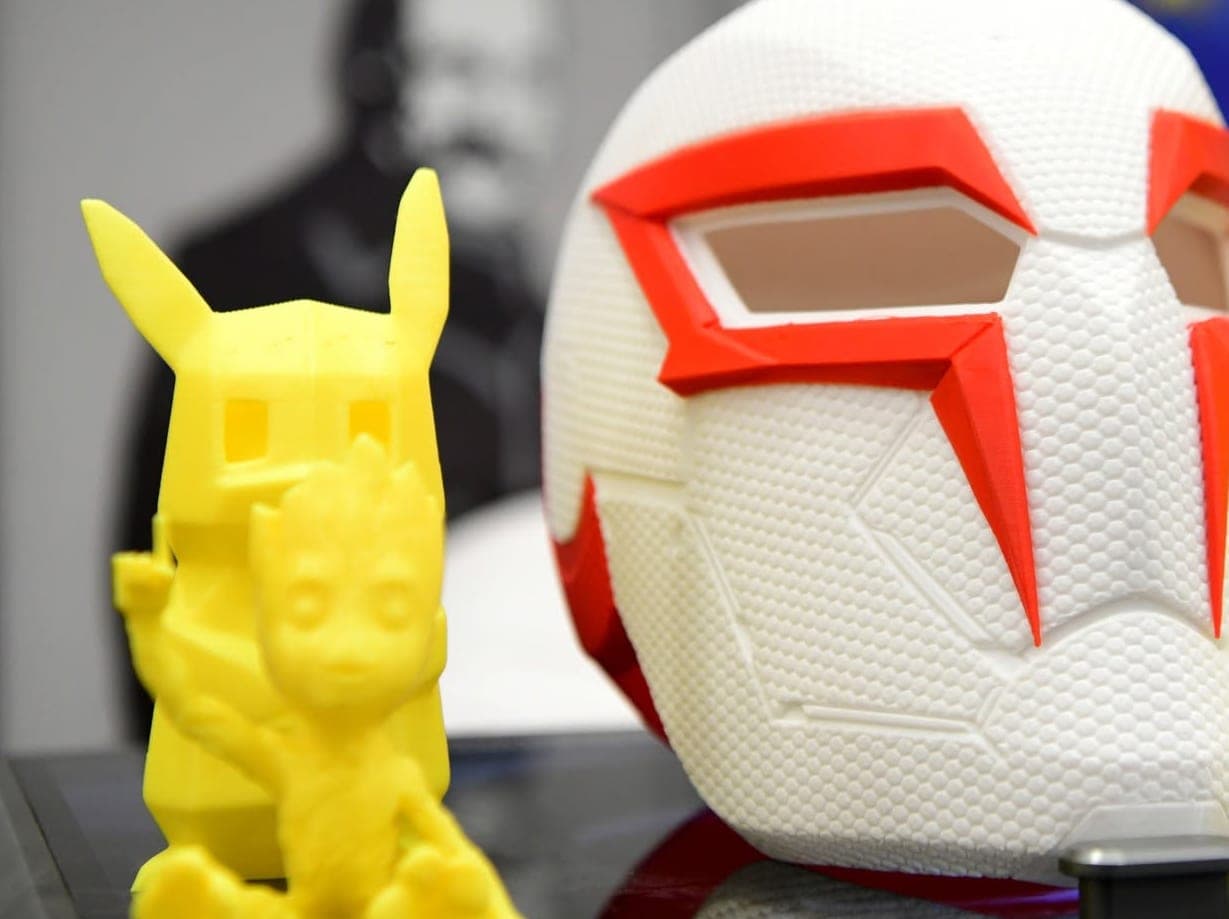
| Miniatures and accessories | Tabletop games, cosplay | Figures, helmet parts | Finishing, painting, licences |
| Your own product | Online buyers | Organiser, lamp, planter | Brand, photos, small batches |
Printing customers’ files is the easiest start, but price competition is fierce. Replacement parts create the most value: nobody sells that broken plastic piece, so people will pay for measuring, modelling and printing. One exception: safety-critical parts (brakes, steering, child seats, load-bearing brackets) should never be 3D printed.
For a full list of ideas with difficulty and material, see 40 3D printing ideas. If you can also laser cut, combining the two makes products more interesting: laser cutting ideas.
How to choose a niche and find your first customers
The most common mistake is an “I print anything” advert. Customers look for a solution to a specific problem, so start with one direction you understand yourself:
- Write down what you already know. Cars, music, tabletop games, gardening: expertise builds trust in a community.
- Test demand. Print 5–10 samples, take good photos and see what people ask about on social media.
- Find partners. Architecture firms, design studios, repair shops and schools become repeat customers.
- Do not compete on price alone. Speed, quality and advice matter more than a keychain that is 2 GEL cheaper.
- Keep a price list ready. Customers prefer an answer the same day.
What does one print really cost?
Many people price a print by filament alone. In reality, the cost of one print has six parts. Take an example: a phone stand, 60 grams of PLA and 3 hours of printing. The figures are illustrative; plug in your own.
| Cost | How to calculate | Example |
|---|---|---|
| Filament | grams × spool price / 1000 | 60 g × 60 GEL / 1000 = 3.60 GEL |
| Electricity | hours × kWh per hour × tariff | 3 × 0.15 × 0.29 = 0.13 GEL |
| Printer wear | printer price / working hours | 2000 GEL / 4000 h × 3 = 1.50 GEL |
| Failed-print reserve | 10% of the lines above | 0.52 GEL |
| Packaging | box, label | 1.50 GEL |
| Your time | prep, finishing, packing | 20 min × 30 GEL/h = 10 GEL |
| Total | 17.25 GEL |
Under the regulator GNERC’s 2026 tariffs, household electricity in Tbilisi costs 20–29 tetri per kWh including VAT, depending on monthly consumption; the small-business tariff (220/380 V) is about 35 tetri. Tariffs change, so check the current figures on gnerc.org. Measure your printer’s real consumption with a plug-in power meter, as it depends on bed temperature and material.
The key lesson: in this example filament is only 21% of the cost and your time is 58%. Pricing “by the gram” almost always means selling at a loss.
Pricing formula: how much to charge for 3D printing
A simple formula that works for most orders:
Price = (cost + design hours × hourly rate) × (1 + profit margin)
In our example, with a 30% margin: 17.25 GEL × 1.3 ≈ 22.43 GEL. With a ready file, design hours are zero. If you have to model a part from scratch for a customer, charge modelling separately by the hour: one complex part can take 2–3 hours.
Three common pricing mistakes:
- Counting only material and treating your time as free.
- Ignoring failed prints: some parts succeed only on the second attempt.
- Giving design away. Modelling is a skill and has its own price.
Before you quote, run the part through your slicer: it shows the exact grams and print hours. The same stand at 0.2 mm and 0.12 mm layers differs roughly 1.5–2 times in print time, so the quality level belongs in the price.
Example 2: a copy of a broken bracket. Measuring and modelling take 1.5 hours × 30 GEL = 45 GEL. Printing in PETG: 25 grams and 2 hours; including one test print, the cost is about 13.40 GEL. Price: (13.40 + 45) × 1.3 ≈ 76 GEL. Three quarters of that price is design, and that is fair: the customer is buying a part nobody else sells.
How to handle a replacement part order: 7 steps
Custom parts go well when the process is defined in advance:
- Ask for photos, measurements and, if possible, the broken part itself.
- Clarify where it will work: load, temperature, sunlight, water. That decides the material; see PLA, PETG or ABS.
- Model it and have the customer approve a render or screenshot before printing.
- Print a quick test version and check the fit.
- For the final print, orient the part so the main load runs along the layers: the bond between layers is the weakest point.
- Finish it: remove supports, sand, add threaded inserts if needed.
- Photograph it for your portfolio and ask the customer for a review.
Licences: what you are not allowed to sell
You cannot automatically sell prints of a model you downloaded. Every model has a licence:
- CC BY and CC BY-SA allow selling prints, as long as you credit the designer.
- NC (NonCommercial) licences forbid selling. Many models use them.
- The Printables store has a separate Commercial use licence that allows selling prints.
- On MakerWorld, some designers sell commercial licences through paid memberships.
- Brands and characters (films, games, logos) are protected regardless of the file’s licence.
The safest route is your own design: it is your asset and hard to copy. If a customer brings their own file, ask them to confirm they have the right to use it. A licence table and site comparison are in our guide to free STL files and slicers.
How to register a 3D printing business in Georgia
For regular sales, registering officially is the better choice. The general path (as of 2026; check the details with official sources):
- Register as an individual entrepreneur with the National Agency of Public Registry (napr.gov.ge).
- Apply for small business status. Under the Tax Code, it can be granted to an individual entrepreneur whose annual income does not exceed 500,000 GEL. The Revenue Service (rs.ge) grants it on application.
- Tax. With small business status, taxable income is taxed at 1%. If income exceeds 500,000 GEL, the rate is 3% from the month the threshold is crossed until year end, and exceeding it two years in a row ends the status.
- Micro business. The Code also has a micro business status: no hired staff, annual income up to 30,000 GEL, and no income tax. Some activities are excluded from these regimes, so check first.
As turnover grows, an obligation to register for VAT can also arise. This is general information, not legal advice: talk to the rs.ge hotline or an accountant before you register.
Which printer does a 3D printing business need?
For a business, reliability beats speed: a printer that finishes long prints without failures. If you ever leave a long print unattended, make sure the firmware has thermal runaway protection, there is a smoke detector in the room and nothing flammable around the printer. Ventilate the room well when printing ABS and ASA. Choose a model with easy-to-find spare parts and an enclosure for ABS and ASA. Start with one printer and buy a second when your order queue is longer than a week. More on choosing: which 3D printer to buy.
 Course at TDS3D Design & 3D Printing6 weeks · 32 h · Starts 18 NovDetails
Frequently asked questions
Is a 3D printing business profitable?
It can be, if you sell design, measuring and advice, not just plastic. File-printing services face strong price competition, while custom parts and your own products carry higher margins.
How much does 3D printing cost in Tbilisi?
There is no fixed price: it depends on the amount of material, print hours, quality and finishing. Services usually charge for material, time and setup. Calculate your own price with the formula above.
What should I sell with my 3D printer?
Start with a narrow niche you understand: replacement parts, personalised gifts or accessories for a specific hobby. Print 5–10 samples first and test demand.
Can I sell prints of Thingiverse models?
Only if the licence allows it. CC BY and CC BY-SA models can be sold with credit to the designer; NC models cannot. When in doubt, ask the designer for written permission.
Do I need to register as an entrepreneur?
For regular sales, yes, it is the better choice: with small business status the tax is 1% on annual income up to 500,000 GEL. Check the current conditions on rs.ge or with an accountant.
How many printers should I start with?
One. In the first months the hard part is finding customers, not printing capacity. Buy a second printer when your order queue runs longer than a week or you regularly need two different materials at once.
Next step
A business starts with a product you can design yourself. On the 3D Design & 3D Printing course you learn parametric modelling in Fusion 360, parts that fit together, materials and small-batch production, and finish by presenting your own product. Comparing options? See tech courses for adults.
Sources
- Tax Code of Georgia, Articles 84–90, Legislative Herald of Georgia
- National Agency of Public Registry
- Revenue Service of Georgia
- GNERC releases official information on new electricity tariffs, 1TV
- About CC Licenses, Creative Commons
- Printables Store Launch, Prusa Research Blog
- Commercial License Membership, Bambu Lab Blog